Thursday, October 23, 2014

The Casualties in Changing Congregations


Last week we hosted long-time friends who were passing through on their way to a university reunion. These are active United Church laypeople and she is the sort of engaged, thoughtful Christian whose leadership skills would be an asset in any congregation. I have always found her positive and ready to face the challenges and changes of church life.

During our evening chat we realized how hurt and even angry she is about the recent departure of their minister. The minister announced her departure without warning after only a few years with them. She was admired by the flock and was offering innovative and meaningful worship leadership. So why would she leave, and not give the congregation a chance to negotiate through concerns? No one including the Board chair and Ministry and Personnel committee were aware of what was unfolding. I could tell our friend took this personally, as a form of betrayal in a way, and I can understand why. That is often the feeling, even after long pastorates.

At the same time I know the situation in the congregation well, and it is a demanding place to be. It is just a complicated ministry which requires constant vigilance and problem-solving. The minister probably felt that it was easier to leave and start again. It certainly wasn't for greener pastures, and the folk she left are really good people. But in these complicated times it can be difficult to see a way forward for clergy.

As I listened I figured everyone had lost something. I am sure Christ is still present in the congregation, but their loss of leadership is significant. The minister is a person of abiding faith who will take her gifts elsewhere. But there are many casualties in these unsettled times for the church, and it all seems rather unfair. I'm sure that most people have little idea how bewildered many clergy feel as they attempt to preach and live the Good News in times which seem to be really bad news.

Have you gone through a similar experience of loss? It is wrong to be hurt by a minister's departure or is it just one of the realities of grief?

Wednesday, October 22, 2014

Unholy Segregation

 
An Israeli member of the "Woman of the Wall" organization, right, tries to hug an ultra-Orthodox woman as they pray at the Western Wall, the holiest site where Jews can pray, in Jerusalem's old city.


Once again there is controversy in Israel over the claim of some Jewish women to equality in worship and expression of their faith. The latest stir came as ads were posted on buses by the group Women of the Wall, which seeks to achieve equality at the Western Wall, the holiest place where Jews can pray. The advertisements showed girls and women wearing prayer shawls and holding a Torah scroll — rituals seen by many Orthodox Jews as reserved for men only. Many of the signs have been vandalized because they promote Bat Mitzvah ceremonies for girls at the Western Wall. The coming-of-age ceremonies for girls are only allowed to be held at a nearby prayer site, designated for worshippers who don’t follow the orthodox tradition.

Every time I see stories such as these I'm startled, and I'm aware that we are still a long way from equality, in no small part because of fundamentalist religion. It certainly isn't exclusive to Judaism, or Islam for that matter. I follow threads of conversations on Twitter in which Christian women are attacked viciously for claiming equality with men. Many denominations still do not ordain women nor recognize their calls to ministry in other that secondary roles.  It is so far from the current experience in the United Church, with women in virtually every leadership role, although there are still inequalities in opportunity in our denomination.

Do you remember times when women were restricted in their leadership opportunities, or viewed as second-class to men? Do you feel that there is equality in your denomination now, or are there still "glass ceilings?"
 

Tuesday, October 21, 2014

Delusions of Brand-eur

 
We've been having a worthwhile discussion in our Bridge St. Governance Board about how we get the message of our Christian community out to the wider community which is Belleville. The words "marketing" and "branding" have come up regularly. Some folk like 'em, because they are using them on a regular basis, and others don't, because they smack of commercialism and selling a product.
 
Of course those who promote branding argue persuasively that it is way of establishing values and identity which are then shared with a target audience through marketing. What we are realizing in the church is that we have rather smugly assumed that everyone in our culture knows who we are and what we stand for. Unfortunately this is far from true, so our image is shaped by absence. In a time when so many carry around a shopping cart crammed with negativity about organized religion we have failed to share our good news, which is all the positive ways we are responding to the Good News of Jesus Christ.
 
Our oldest daughter, Jocelyn, gave me a book for my birthday called Branding for Nonprofits: Developing Identity with Integrity. The title sure works for me. The author, DK Holland has developed four branding markers:
  • Reputation: How well is the brand known by audiences?
  • Esteem: How highly do its audiences rate the brand?
  • Relevance: How much do the brand’s audiences care about what it does or stands for?
  • Differentiation: How different is the brand from others? Are other brands similar?
 
41LqgSMOYJL__SL500_AA300_
 
A recent issue of the United Church Observer shared poll results that found most Canadians don't have any more than a vague clue about our denomination, so both our branding and marketing have failed. The United Church offers an alternative to more right-leaning theology, but we haven't conveyed our commitment to social change, inclusivity, and a heart/mind Christian theology. Closer to home, many of our folk at Bridge St. are frustrated that we have a reputation as the hoighty-toighty church, where the rich and arrogant hang out together. My 18-month experience as pastor here is of warm, caring, thoughtful people who have a meaningful faith and want to deepen it through worship. Again, we apparently haven't done our work effectively when it comes to branding or marketing.
 
At least we're talking about it! Now we have to do it, even if we don't use the B and M words. We could call it evangelizing, another word which makes mainliners uncomfortable, but we really do need to get over that reluctance, it seems to me.
 
What about you? Are you okay with terms such as branding and marketing? How about evangelizing? If not these three, how do we describe the important work of getting our message and Christ's message out there?
 

Monday, October 20, 2014

Accountable


Alan Henning
 
We have been sickened by the barbarism of ISIS/ISIL executions of Westerners in the past couple of months. None of these murders has made sense, but the recent killing of a man from Great Britain, Alan Henning, who was in Syria to provide aid to suffering children was especially atrocious. I find I must fight back my fury each time because of the sheer cowardice.

Because of the international outrage a number of nations, including Canada, have gone to war against these terrorists, in what is to me an ill-defined mission. I also find it bizarre that Saudi Arabia is part of this coalition because a principal form of capital punishment for the kingdom is beheading. Since the beginning of 2014 approximately seventy people have died this way, often for crimes which would receive moderate sentences in many of the other coalition nations. These beheadings happen publicly, as Saudi Arabia is one of several nations which hold public executions.

This isn't the only form of brutal execution in the world. We are reasonably sure that China executes some criminals by a gunshot to the head, and not necessarily by firing squad. There are nations, including Saudi Arabia, which still crucify convicted criminals.

While we may view all this as barbaric, recent incidents in the United States of botched executions by lethal injection have led to new discussions and protests against capital punishment. How does this happen in a country where so many claim Christian values? It wasn't that long ago that capital punishment was an option in Canada, although we can thank God that it hasn't been applied in more than fifty years.

The history of movements to abolish capital punishment has included many Christians who have worked tirelessly and effectively to bring it to an end. We agree that actual criminals must be held accountable for their actions, and we should feel outrage at terrorist acts. But executions for any reason should be called into question in civil and enlightened societies.

Comments?

Sunday, October 19, 2014

A Good Death


Could you give me a minute to search through all the scripture passages on physician-assisted suicide. Okay, done. There are none. This is part of the challenge for those of us from the Judeo-Christian tradition in regard to assisted suicide.

The bible gives us the broad strokes of the sanctity of life, human and non-human. Christianity has developed a theology and ethic of the preciousness of life which challenged infanticide in Roman culture. This led to a strong stance in the Roman Catholic church and most evangelical denominations on abortion as well. And many denominations have taken stands against suicide of any kind, sometimes claiming that heaven's doors will be blocked to those who take their own lives.

Why then has the discussion on assisted suicide moved to the foreground of society, including this week's debate in Canada's parliament? In part it has to do with our changing convictions about individual choice. There is another reality though, which is our increasing lifespans. In developed nations we are living longer than our forbearers. When I was born in 1954 life expectancy was roughly 68 in Canada. Sixty years on it is 82, and we are one of the top nations for longevity in the world.

Unfortunately, living long doesn't necessarily mean living well. Even those with access to the best medical services and palliative care may conclude that live is no longer worth living because of severe physical restrictions, mental anguish, or pain. There have been a number of high-profile challenges to Canadian laws on suicide in recent years, and it's hard to imagine not being touched by the plight and desire of these individuals.

Again this past week we entered into the debate, which always presses us to ask what the parameters for assisted suicide might be, how we will protect those most vulnerable in our society, and who will be the gatekeepers and technicians for this form of death.

Our United Church moderator, Gary Paterson, has offered a thoughtful reflection on the subject http://www.united-church.ca/communications/news/releases/141014, drawing on his experience with his aging and ailing mother. It is worth reading, as is the debate summarized in the Globe and Mail http://m.theglobeandmail.com/globe-debate/read-and-vote-should-patients-be-allowed-to-request-suicide/article21106527/?service=mobile&click=sf_globea and a piece in Walrus magazine. http://thewalrus.ca/and-when-i-die/

You might revisit a United Church Observer article about Gloria Taylor, one of our members who wanted the right to end her life, although she died before taking the steps to suicide. http://www.ucobserver.org/features/2012/09/gloria_choice/

Rather than saying anything more, I encourage you to read and reflect. It is so important for Canadians to be informed on this subject, because we are at an important crossroads. We can also pray for all those who are in the final stages of this life and desire a "good death," which is what euthanasia means.

Thoughts?

Saturday, October 18, 2014

Coincidence and Providence


Our son Isaac is a United Church minister but because he works in a team he had the Thanksgiving Weekend off and his family could join us for the weekend. They were present for worship at Bridge St. Church and Ike brought grandson Nicholas, who is almost two, forward for the Children's Time. I wasn't prepared for the wave of emotion I experienced seeing him in his Dad's arms. It was only the other day that our three children were coming to the front for the same moment in the service, or so it seems. I am so proud of all three of them as adults and it was lovely to have them and their partners with us on Saturday to celebrate my birthday.
While with us Isaac picked up a plastic tote my brother had with papers related to my father's life. Both my father and his brother were United Church ministers, and both have been gone for a number of years. Later on Thanksgiving Monday Isaac texted me from home. He had discovered in his rummaging that Dad, his grandfather, had been ordained at Bridge St. in 1954, just a few months before my birth.

I knew that my father, George Mundy, had been ordained in Bay of Quinte Conference. I had no idea where, and of course he died long before my move to Belleville. Yet here I am, serving in the congregation where his ministry was inaugurated. The United Church is certainly very different now from the denomination of the post-war years and from the church into which I was ordained in 1980. The clergy of Isaac's generation are the courageous ones.

I believe this is where I'm supposed to burst into a chorus of The Circle of Life! Actually, this news, shared in a couple of lines of a text message, has been a constant companion in the few days since. I'm not sure why, but is seems like an unusual coincidence -- or is that providence. I'm grateful that my son was curious to find out more about his family history. I might never have known otherwise. Perhaps God just wanted me to be aware.

Oh yes, Bridge St. UC has been approached to host the Celebration of Ministry service at Bay of Quinte Conference in 2015.

Friday, October 17, 2014

Chew on This!


During November we will engage in conversation around Sara Miles' provocative and worthwhile book called Take This Bread. Miles was an avowed atheist who became a Christian passionately involved in the food ministry in her congregation. Bridge St. United Church has two important meal ministries. One is called Inn from the Cold and it provides hot, sit-down meals during a six-week period in the coldest part of the winter. Thank God It's Friday is a once-a-week distribution of frozen meals. These ministries combine to provide over 8,000 meals with 150 volunteers involved. I think the work is impressive,

Still, one of the questions we need to ask is why we do this as a congregation. Another is what meal distribution contributes to the bigger challenge of food security for those who are at the margins of our affluent society. The metaphor of rescuing children repeatedly from a raging river without ever asking what is happening upstream to put them there is apt. We don't want to be involved in meal distribution to assuage our consciences, nor do we want them to be a bandaid for the real wounds of those who need systemic change.

Today volunteers in 12 cities will hand out paper bags with the words Chew on This!, as well as a postcard describing the food security or insecurity situation in Canada. This is the International Day for the Eradication of Poverty. The hope is that the federal government will create a plan for poverty elimination through a number of prongs, but there have been plenty of plans put forward by different levels of government through the decades which have been stillborn.

As I have said before, I think it is hopeful that different agencies including congregational food ministries are coming together in Belleville to develop their own strategies for support and advocacy.

Any comments about the meal ministries offered at Bridge St. and other congregations? Today meals will be distributed here, with grateful recipients. Have you been involved in developing any "bigger picture" strategies in your community to support those who struggle to eat well? Is this as aspect of our Christian faith and commitment to justice?

Thursday, October 16, 2014

Opening the Door of Acceptance?

A priest takes a picture as Pope Francis celebrates a Mass to mark the opening of the synod on the family in Saint Peter's Square at the Vatican October 5 2014

More than 200 Roman Catholic bishops gathered in Rome this week for a Synod on Family that some are comparing to Vatican II. Why? Well the discussion will address core teachings of the Catholic church, including marriage, contraception, abortion, divorce, and homosexuality.

In his opening Pope Francis urged these bishops not to impose what he called "intolerable moral burdens" on believers. While there are RC's who are encouraged that this is one more step along a road that Francis has invited the faithful to travel toward greater openness and tolerance, others are in wait-and-see mode. Conversation isn't the same as a change in doctrine and there are conservative bishops who are already expressing opposition to the tenor of the discussions.

There is a good article in The New Yorker which addresses the "graduality" explored in this document, a change in outlook, if not in doctrine. http://www.newyorker.com/news/daily-comment/bombshell-document-vatican-synod

Here is the section on homosexuality.

Welcoming homosexual persons

     50.        Homosexuals have gifts and qualities to offer to the Christian community: are we capable of welcoming these people, guaranteeing to them a fraternal space in our communities? Often they wish to encounter a Church that offers them a welcoming home. Are our communities capable of providing that, accepting and valuing their sexual orientation, without compromising Catholic doctrine on the family and matrimony?

     51.        The question of homosexuality leads to a serious reflection on how to elaborate realistic paths of affective growth and human and evangelical maturity integrating the sexual dimension: it appears therefore as an important educative challenge. The Church furthermore affirms that unions between people of the same sex cannot be considered on the same footing as matrimony between man and woman. Nor is it acceptable that pressure be brought to bear on pastors or that international bodies make financial aid dependent on the introduction of regulations inspired by gender ideology.

     52.        Without denying the moral problems connected to homosexual unions it has to be noted that there are cases in which mutual aid to the point of sacrifice constitutes a precious support in the life of the partners. Furthermore, the Church pays special attention to the children who live with couples of the same sex, emphasizing that the needs and rights of the little ones must always be given priority.

You may be thinking that this is hardly radical change or that the Roman Catholic church speaks out of both sides of its ecclesial mouth. I do hope that this is movement toward the Christian embrace of so many who have felt excluded and alienated by the church they have loved and often served. It's not just about the LGBTQ community. I have friends and acquaintances who have been ostracized over issues of divorce and remarriage and have never recovered.

What do you think about this Synod or do you care?

Wednesday, October 15, 2014

Rethinking Columbus Day

Native American protesters have been demonstrating against Columbus Day in Seattle for several years. Protest organizers say Columbus should not be credited with discovering the Western Hemisphere at a time when it was already inhabited.

Monday Canadians celebrated Thanksgiving while in the US it was Columbus Day. As the name suggests, this is the day Americans have traditionally celebrated the discovery of the Americas by Christopher Columbus and the crews of three ships commissioned for the voyage. Of course First Nations people, the Vikings, and the Irish would all beg to differ. When Columbus arrived, searching for India, he discovered lands inhabited by developed cultures which had been established on the continent for thousands of years. With typical European hubris these cultures were dismissed as heathen and savage, and often decimated or exterminated. The church was often complicit in the twisted rational which allowed the inhabitants to be slaughtered because they weren't Christian.

It is an ugly history to be sure and celebrating Columbus as a hero doesn't make a whole lot of sense. Some cities have decided not to call the day after Columbus, instead renaming it as Indigenous People's Day. A piece on the NPR websites reports on what has happened in Seattle:

"This is about taking a stand against racism and discrimination," Seattle City Council member Kshama Sawant told the Seattle Times. "Learning about the history of Columbus and transforming this day into a celebration of indigenous people and a celebration of social justice ... allows us to make a connection between this painful history and the ongoing marginalization, discrimination and poverty that indigenous communities face to this day."

 
Slowly but surely we are waking up to the pervasive and persistent wrongs of subjugation. We have learned to say we're sorry, although sincerity is sometimes in question. We are realizing that many of the long-standing nicknames and mascots for sports teams are offensive, although owners and fans are slow to relinquish them. Think of the Washington Redskins and the "tomahawk chop" for the Atlanta Braves.
 
When the 500th anniversary of Columbus' arrival was recognized in 1992 in began with a bang and ended with a whimper. I wonder if it would have happened at all with today's awareness?
 
Let's pray --literally-- for a continuing change of perception everywhere, including in the church.
 
Thoughts?

Tuesday, October 14, 2014

A Greater Good?


Last week I read Ian McEwen's latest novel, The Children Act. McEwen is a deft writer and in this book he explores the role of society in both protecting the vulnerable and ensuring the greater good.  The story focuses on a court case in which a family of Jehovah's Witnesses wants the right of choice for the seventeen-year-old son to refuse a blood transfusion. The young man has leukaemia and without the transfusion he will die. The story is told from the perspective of the judge who must rule in this complicated case. There are issues of religious freedom and the grey area of the son's age. He does not want the transfusion but is still a minor, by a few months. I won't spoil the story by spilling the beans on the outcome, which is not predictable.

In the same week we heard about an aboriginal family which refused chemotherapy for an eleven-year-old daughter, Jada, insisting that they would follow traditional ways rather than introduce poison to the child's body. Doctors were convinced that the therapy would likely save the girl's life, but the family said no, then disappeared, probably to the States. There is a religious or spiritual element to this story as well.


When does the state have the right to make these decisions? And what happens when individuals or families insist that saying no to treatment is a freedom based on religion? I think that there are times when the best interests of the person, particularly children, trumps religion, if it means saving a life.

What do you think?

Take a look at my latest Groundling blog entry on the city of Detroit
http://groundlingearthyheavenly.blogspot.ca/2014/10/a-new-green-detroit.html

Monday, October 13, 2014

Cremains of the Day


I wish I could claim this clever post title as my own but it is actually from an article in the Daily Beast about a memoir by former crematorium worker, Caitlin Doughty called Smoke Gets in Your Eyes. Doughty has been on YouTube for a while with an often funny, very practical series called Ask a Mortician.https://www.youtube.com/user/OrderoftheGoodDeath

As the article offers: "Doughty is the founder of The Order of the Good Death, a group of death-industry professionals, academics, and artists exploring ways to prepare a death phobic culture for their inevitable mortality." http://www.orderofthegooddeath.com/

Good for Doughty, and others who are coming up with creative ways to acquaint people with the reality of death. As I've said before, I feel that death is highly overrated, and I'm generally against it, even though I'm a resurrection guy. Still, we all die, whether we want to contemplate it or not. This used to be the role of the church. More and more it has become the ballywick of the funeral industry, which can sometimes, although certainly not always, sanitize death. You may have read my previous rants about how funeral and memorial services have often become death-denying events where participants act as though no one has died.

I still think congregations are places where death can be addressed honestly, even as we affirm a life to come. But why not benefit from the experience of others or gatherings such as death cafes-- no, really. http://www.ourhouse-grief.org/education/the-death-cafe/

Be honest, are you in death-denial? Do you find that it's hard to have a discussion about death with loved ones? Are you glad that Doughty and others are addressing death head-on? Should Christians be more open to talking death than others?

Sunday, October 12, 2014

Our Thanksgiving Door

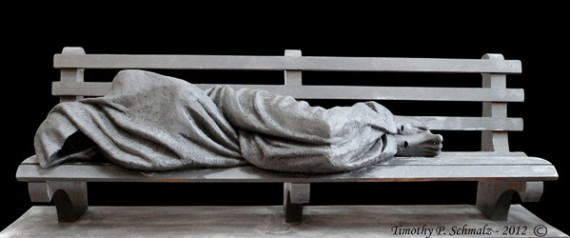
HOMELESS JESUS
Jesus the Homeless-- Timothy Schmalz

Today people most will enter Bridge St. Church from the Church St. door rather than the Bridge St. door. The Bridge St. entrance is our through-the-week business door. People come and go from the office and enter for meetings and events.

The Bridge St door is also the one through which folk enter for our Thank God It's Friday meal distribution program and for the six weeks of Inn from the Cold in January and February. This would be the "poor door" to us Heidi Neumark's term in a recent Christian Century article. She observes that that there is class separation in many congregations doing worthwhile social service work. She speaks of the front-door people and side-door people and I was jolted by her descriptions because they are true. She is too close to home when she says that many churches are involved in social service rather than social change.

I am now serving my fourth congregation with a significant meal program. The 8000+ meals of the meal ministries at Bridge St. are remarkable. There are more than 150 volunteers who impress me no end. I have always wondered if we create two congregations with these outreach ministries and what Jesus is calling us to do.

As I was writing this on Friday a young guy came to the door seeking financial help for baby formula. We have a fair number of people with a variety of woes and needs. Again, our congregation is very generous to our Benevolent Fund. But we rarely see any of the folk we assist through the week on Sundays and I understand why they don't come.

This Thanksgiving I will ponder this some more. Is Christ's calling us to move beyond side-door and front-door congregations? The gospel message doesn't have two doors. What would that be like for us?

Comments?

Saturday, October 11, 2014

Milking Profits


Campaigner
When I began ministry 35 years ago my first pastoral charge was in very rural Newfoundland. At the time the United Church was involved in a boycott of Nestlé's products because this international corporate giant was actively involved in convincing women in developing nations to forego breast-feeding and purchase Nestle powdered infant formula instead. This was represented as better for the babies but it wasn't. The mothers were often using contaminated water and adding more than indicated to stretch the formula, therefore inadvertently poisoning their children and causing malnutrition. Babies were dying of diarrhea and other intestinal diseases.

I was pleasantly surprised that my earnest efforts to convince folk in the five outports I served actually worked. At that time just about everyone used Nestlé's tinned milk in their tea, a practice that left the drinkers' teeth feeling as though they had been broadloomed! Lots of people told me they had switched to another manufacturer, which was really encouraging until I found out that despite the different name the alternative company was a Nestlé's subsidiary.

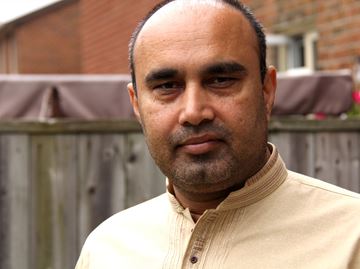
I thought of this modest attempt at justice when I saw recently that a film has been made about the life of the Nestlé's formula salesman-turned-whistleblower who now lives in Mississauga and works as a taxi-driver. Syed Aamir Raza Hussain (above) sold the formula until a doctor in Pakistan took him into a hospital ward of malnourished babies and explained what was happening. This was in the 1990's, years after the World Health Assembly passed the “International Code for the Marketing of Breast-milk Substitutes.” Hussain quit his job and eventually produced a report called Milking Profits in which he decries the practices of Nestlé's to promote infant formula by giving "gifts" to doctors and other health officials to do so.

Life has been difficult for Hussain ever since he decided to speak out about his former employer and he was nearly deported from Canada along the way. Now there is a film on Hussain's efforts called Tigers which was screened at TIFF in September. His story is finally being told.


Do any of you recall this boycott? Do you find it discouraging to hear what has transpired, both in the circumvention of the Code and what has happened for Hussain? Here's hoping that the film will make a difference.


Friday, October 10, 2014

Going to War Again


Canada is off to war again, although we don't seem to want to call it that. The cowards and killers of IS, ISIS, ISIL -- so many letters!-- are the target.  This decision of parliament is tied to the debate about national security, the possibility that terror could come to our cities and towns. In the words of Foreign Affairs Minister John Baird:

“This is not just another conflict. The struggle is not against a state or even a foreign dictator. This is a struggle against a group of terrorists that rape and pillage and slaughter anything and anyone that stands in their way. These terrorist are creating a proto-state, a place where they can train for attacks against Canada and the West.”

I don't disagree with Mr. Baird about the terrible crimes committed by this group. I am not so sure that even a concerted military action will be the answer. While some of them will be "degraded and destroyed" there isn't a scrap of evidence that terrorism can be extinguished this way. I realize that I am in the minority of Canadians in this regard.
REUTERS Photo

I am also trying to think and pray my way through the "fear factor," the notion that we must destroy these terrorists in Iraq and Syria to keep them from our shores. I have no doubt that people, mostly young men, are being radicalized in Canada and contemplating terrorist acts. But how does killing terrorists in the Middle East stop "born and bred" terrorists doing their worst here? And are we being manipulated into compliance by fear?

I have two daughters who work in Toronto and so do their partners. One of them works very close to the site where an incendiary device was detected and detonated in downtown TO last November. I try not to be anxious about where they go about their daily lives and what might happen. I also do my best not to have my opinions shaped by the unfocussed rhetoric of "security." We know that in the past this has led individuals and nations into decisions which weren't based on reality. We have incarcerated whole groups of people without good reason and we have entered into conflicts with no clear purpose and at huge cost, including the loss of our military personnel.

I hope we will engage in prayer for decisions based on facts and truth, not fear.

Thoughts?

There is a new Groundling blog entry for you to read today http://groundlingearthyheavenly.blogspot.ca/2014/10/monkeys-in-heaven.html


Thursday, October 09, 2014

The Matthew Process

So when you are offering your gift at the altar, if you remember that your brother or sister has something against you, leave your gift there before the altar and go; first be reconciled to your brother or sister, and then come and offer your gift.

Come to terms quickly with your accuser while you are on the way to court with him, or your accuser may hand you over to the judge, and the judge to the guard, and you will be thrown into prison. Matthew 5:23-25

We have watched the television drama, The Good Wife, regularly and avidly for several years. This show cleverly interweaves politics and law and relationships. it is well-acted and while the plot-line has dragged at times, the producers and writers keep re-inventing. One critic observed recently that The Good Wife might be a cynical social commentary because corruption and deception abounds and even the supposedly good people, including "good wife" Alicia, can be rather shady in their dealings.

This past week the show got religion, not for the first time, but with an interesting turn. One of Alicia's firm's clients owns a corporation which produces GMO seeds. He takes a farmer to court for illegally planting seeds harvested from his own crop. As strange as that may sound, proprietary rights for seed rests with the company which has the patent in both the States and Canada.

These two men are actually neighbours and both are Christians, so they decide to leave the courtroom and settle their dispute through biblically-based arbitration called The Matthew Process. It is based on the teaching of Jesus as found in what is often called the Sermon on the Mount in Matthew, chapter five.

The lawyers are still involved, so they begin searching scripture to make their points. Atheist Alicia turns to her teenage daughter Grace, who has become a Christian through friends. It turns out that Grace has developed a mature approach to scripture, gently admonishing her mother for "proof-texting," cherry-picking verses out of context. When Alicia asks Grace whether she really believes the bible, she admits that she doesn't take it all literally, but offers that it can be "true in another way." Alicia is impressed and so was I. It is rare to see anything but cartoonish portrayals of Christians and the bible on television.

Eventually the two adversaries choose to act on their Christian faith and reconcile, the way Jesus invites us to do. Go figure!

Does this plot-line surprise you in this rather anti-religious climate? Are you going to find the episode (it is "on demand")?

Wednesday, October 08, 2014

Journeys of Discovery


We are awaiting the release of the film Wild, based on the best-selling autobiography Wild: From Lost to Found on the Pacific Crest Trail   by Cheryl Strayed and starring Reese Witherspoon. The story is one of self-discovery along the demanding 1,100 miles West Coast Trail. At age 26 Strayed's life was adrift, having experienced the death of her mother and making choices which were destructive. She set out on this lengthy hike which became what might have been called a pilgrimage in another time. Some critics are saying that this is Witherspoon's best acting since Walk the Line, while others who are less kind suggest that she has chosen a role calculated to bring her an Oscar nomination. I haven't read the book, but it sounds like a very readable exploration of what the rigours of an outward, physical, even dangerous journey can bring to the inner, spiritual journey.

The film won't be released until early December, but all this talk about Wild coincides with a traditional pilgrimage, the Hajj. More than two million Muslim pilgrims will made their way to Mecca in Saudi Arabia, between October 2nd and 7th. The name "hajj" means the intention of a journey, which is as important as the destination.

Despite the tradition, and the organization, this pilgrimage always has its own dangers. That many people brought together for what is one of the largest human gathering on the planet jostle and stumble and there have been fatal stampedes through the years. I listened to a young Canadian woman who attended two years ago and she spoke of the training she went through here to prepare her for the challenges of being in large crowds. This year there is the added concern of Ebola, since many pilgrims are from Africa.
  
Hall 2014 pilgrimage
 
There is a long tradition of Christian pilgrimage which includes journeys to Canterbury, Jerusalem and Rome. The Camino in Spain has regained popularity in recent decades and our son Isaac, as well as a couple of friends, have made this 800+ kilometer walk to Santiago de Compostela.

Do you think there is a connection between Cheryl Strayed's individual journey of self-discovery and the collective pilgrimage of the Hajj? Have you ever been on a trip that was an intentional pilgrimage, or became one as you travelled? Does this notion of a pilgrimage appeal to you, or would you prefer to lie down until the feeling goes away? 

Tuesday, October 07, 2014

A Prayer of Waiting


 Wait for The Lord. Be strong and let your heart take courage. Wait for The Lord.”
–Psalm 27:14

 
Last week I made the earliest appointment possible to have my vehicle undercoated, in preparation for winter. I wanted to get to work at a regular hour, and I did. I was reminded once again that men of a certain age seem to be earnest about tasks such as undercoating. I was one of several grey-hairs in the office, either waiting or setting up appointments. Fortunately they got me in earlier than my specified time and out rather quickly.
 
I don't like waiting, for anything. I hate drive-throughs, in part for environmental reasons. For events such as the Toronto International Film Festival I will endure a line-up, but I'm a mildly grumpy wait-er. We have waited dozens of times through the years for ferries to various destinations, but no amount of pacing will speed up the arrival or departure of the ship.
 
I waited for the birth of our three children, and one grandchild, always a bit fretful about what will occur during delivery, and then filled with relief and joy. I have kept vigil with families as a sick or elderly loved one lay dying, and I have done my best to be a "non-anxious presence" as we watched life ebb away. In those occasions we have prayed and asked God to be the source of calm and peace as the person moved from this life to the next.

There are many scripture passages which exhort us toward what we might call Godly waiting, an openness and willingness to live beyond impatience because the One who loves us and redeems us is at hand.
 
I like the little prayer below by Elisa Cottrell. It addresses so much in a matter of a few phrases.
 
A Prayer of Waiting 
by Elisa Cottrell
 
In my anxiety, reassure.
In my impatience, endure.
In my discomfort, soothe.
In my frailty, strengthen.
In my waiting… remain.
Amen.
 
What are your thoughts about waiting? Have you learned to wait with a sense of peace, or are you impatient? Is waiting good for the soul?  

Just click on this link to my lastest Groundling blog entry about Jessica Hetherington http://groundlingearthyheavenly.blogspot.ca/2014/10/testimony.html

Wait for the Lord NourishingPassions.com


Monday, October 06, 2014

Common Sense, Left Behind


I am a regular reader of movie reviews and I find Rotten Tomatoes to be handy as an aggregate rating for a film. I have to admit that I felt something akin to pleasure when I saw that the recent release, Left Behind, received a whopping 2% rating from critics. I'm trying to recall whether any film I've seen reviewed has fared so badly.

 Left Behind is an apocalyptic thriller loosely based on the fundy Christian Left Behind series of novels which are themselves loosely based on the Revelation of John, the final book of the New Testament. Does it get much sketchier than that?

I have blogged in the past on these poorly-written, scare-tactic novels which many Christian critics, including many evangelicals, have condemned in no uncertain terms. You may recall that I wrote about attempting to read one of these novels, but ended up stalling in the first chapters because I was so angry at the crappy theology and rampant falsehoods. I tried again with a concluding volume and with the same outcome. It infuriated me that these bestsellers were and are misleading readers about the content of Revelation and, more importantly, the message of God's grace in Christ. 

There was an earlier film of the same name starring teen TV star and rightwing Christian Kirk Cameron, while this one stars Nicholas Cage. What was Cage thinking to get involved in this project?  At least Cameron believes in this bizarre misrepresentation of Christianity. For Cage it has to be about the money, and that's what I figure motivates the novels. While they are presented in earnest Christian language about the return of Christ they are really about capitalizing --literally-- on fear and ignorance. There are so many fundamentalist Christian preachers and writers who thunder away about being prepared for Christ's judgemental second arrival while they live the high life in gated communities and let the royalties roll in. Sadly, this is not an exaggeration and the reputation of all of Christianity is besmirched because of the deception (I have always wanted to use the word "besmirched" and my time has finally come.)

I pray that Left Behind becomes a monumental, money-loosing turkey for those who created it, and if there is justice Cage's reputation will never recover. 

Left Behind is in theatres now, including here in Belleville. Are you tempted to see it, like slowing down for a look as you drive past an accident? Are you baffled by the desire of some Christians to read and view this stuff? Why do you think that this fascination for Christ's return exists when Jesus clearly encouraged his followers not to speculate about the hour or day? 


Sunday, October 05, 2014

The Godly No


Remember the Sabbath day and keep it holy...Exodus 20

Many ministers retire after a career of working on the Christian sabbath only to work part-time on the  sabbbath. For some reason congregations want ministers to lead worship on Sunday, so retirees just keep on going, violating the Lord's Day. The goofy thing is that clergy are inclined to complain bitterly that Sunday's are now wide open for any activity and even churchy folk don't attend worship nearly as much anymore.

Sabbath-keeping isn't just a convention, it is a commandment according to scripture. Today we will hear the Ten Commandments and we will be reminded that this commandment is longer and more detailed than all the rest. You would think we would ask why, but we might be too busy doing other stuff to find out. 

Of course I'm preaching on another commandment --honour your parents-- but I did go on a book hunt earlier this week, ferreting out the volumes I have in my library on the sabbath. I thought I had six but I found a seventh, which nicely corresponds with the notion of a seven-day week but also proves I have a serious book addiction. 

The most recent acquisition is Walter Brueggeman's sabbath as resistance: Saying NO in the CULTURE OF NOW.  Supposedly being a naysayer is not good, but an exception can be made for a day of rest, recovery, re-ordering, recapitulation...the R's could keep on rolling!

Here are the other titles:

The Sabbath Abraham Heschel
Keeping the Sabbath Wholly Marva J. Dawn
Living the Sabbath: Discovering the Rhythms of Rest and Delight Norman Wirzba
24/6 --a prescription for a healthier, happier life Matthew Sleeth MD
Sabbath: Restoring the Sacred Rhythm of Rest Wayne Muller
The Sabbath World: Glimpses of a Different Order of Time Judith Shulevitz

The authors are male and female, Jews and Christians, theologians, an ecologist, and a physician.  They persuasively, eloquently, explore every possible reason for keeping the sabbath. If only we listened!

What are your thoughts on the "Godly no?"


Saturday, October 04, 2014

The Legacy of St. Francis

Today people will gather at various parks and churches for a curious but lovely religious ceremony. It is the annual Blessing of the Animals, an event which coincides with the Feast of St. Francis. Our Bridge St. congregation will hold this simple ceremony tomorrow and I will have the pleasure of bestowing a blessing on the furry friends of our Christian family.


If I had to choose a couple of patron saints the female would be Julian of Norwich and the male would be Francis of Asissi. I have written about Francis before, of how he left wealth and comfort to live a radically simple life. He was soon followed by hundreds and then thousands of young men who created a movement which was recognized by the Vatican in a "if you can't beat 'em, join 'em" concession to the Franciscans. Legends of Francis' care for the poor and ill quickly arose. He was said to literally embrace lepers and others who were shunned by society. He preached to birds and other creatures. He created the first Living Nativity, incorporating animals. Eventually the Poor Clares became the female companion order to the Franciscans. 

Why do I admire Francis? He was a revolutionary by example, and in a way that effected change without discarding a grounding in Christ and the church. He was a mystic, modelling the profound experiential aspects of faith. He took on a radical simplicity for his life that may be the only hope for the groaning creation of Planet Earth. He appreciated all living things as worthy of love and respect because God made them. 

Yes, some of the stories may be legends rather than fact -- did Francis really negotiate with the Wolf of Gubbio to stop terrorizing the locals? But those stories speak of a deep desire to see the world differently, through holy and Christ-washed eyes. 

Any thoughts about the Feast of St. Francis? Will your critters be blessed somewhere this weekend? Should be pay more attention to the legacy of Francis?

Friday, October 03, 2014

Atonement

Gottlieb-Jews Praying in the Synagogue on Yom Kippur.jpg
Jews Praying in the Synagogue on Yom Kippur, by Maurycy Gottlieb (1878)
 
This evening marks the beginning of the Jewish Day of Atonement known as Yom Kippur. It is a solemn and holy day of repentance, which includes fasting and prayer. Atonement has a number of definitions, and is different in Judaism and Christianity.
 
Atonement
            reparation for a wrong or injury.(eg "
she wanted to make atonement for her husband's behaviour")
  • (in religious contexts) reparation or expiation for sin.
    "an annual ceremony of confession and atonement for sin"
  • Christian Theology
    the reconciliation of God and humankind through Jesus Christ.
From my understanding, atonement is an acknowledgement of wrongdoing, and a willingness to choose a new path. As a Christian I do this in the grace of Christ.
 
There is acknowledgement in some Jewish circles that the contrition of this day might include awareness of our human destructiveness of the world God has created. In the Tikkun workbook for the High Holidays the question is asked:


Which of our society’s political, economic, or social institutions have destructive consequences to the environment, social justice, or our capacity to be loving and compassionate human beings? Have you challenged any of them in the public arena?
 
This week I have been sorrowful about the news that in the past forty years half of the wild creatures of the planet have disappeared from the land, and sky, and sea. To put that differently, since I was about twenty years old, 50% of the wild things have faded out of the glorious mural of planetary life. This makes me heartsick. How can this be?
 
I know I can do better. I want to do better. Canadians have one of the largest ecological footprints amongst nations, so that includes me. I won't walk around in sackcloth and ashes, even though I do want to repent of my foolish ways. Instead, I will consider how to live more simply, to walk more lightly, and with a deeper commitment to caring for the Earth. My Christian faith teaches me that God loved humans and the whole wide and wild world so deeply that God chose to be a human, a groundling, in the person of Jesus.
 
If I am truly a Christ-person, I will repent and atone and do my best to create a hopeful world.
 
Thoughts?


Thursday, October 02, 2014

Slouching Toward Mars


So Canadians, are you prepared to go to war? Canadian Christians, are you resigned to our military entering into another conflict? We're told that Prime Minister Harper will announce a combat mission to Iraq, and/or Syria, and/or...does anyone really know what we are up to? There will be no "boots on the ground," the phrase politicians and media adore. It means that there will be no soldiers deployed on the ground, although we have military advisors in Iraq already, and I'm assuming they are not suspended in the air. This engagement will include fighter jets and refueling aircraft to start, but we should all ask what "mission creep" might look like for Canada.


Yesterday it occurred to me that our current prime minister was enthusiastic about getting involved in Iraq in 2003, but then PM Jean Chretien resisted the pressure to enter into that tragic boondoggle. Here we are on the brink of engagement and I sure hope there is a meaningful and honest debate in parliament before we wander into war. I do believe that we must respond to the humanitarian crisis in the region and to the plight of persecuted minorities, including Christians. But who says this must include are military involvement?

Brian Zahnd, an American pastor and writer has dared to challenge the culture of war in his country. He exhorts his readers to follow Jesus as the Prince of Peace rather than Mars, the god of war. He admits that he wanted to wait until later in life to write A Farewell to Mars because he has a lot to lose in a nation that is seduced by its perceived role as the world's policeman. But his love for three grandchildren would not let him delay the prophetic message.

Are we prepared to meekly stand by while this decision is made on our behalf? Are wil willing to slouch toward Mars? What do you feel about military involvement --again-- in the Middle East?

Wednesday, October 01, 2014

Two Gifts


I have received two lovely gifts in the past couple of days and I'm sure that the folk that offered them had no idea how meaningful they were despite my thanks. On Sunday morning one of the men who was at worship approached me. He observed that in the year or so I have been at Bridge St. UC I have nudged the congregation toward the 21st century in terms of visual display, music, bulletin covers and even format for the sermon. He felt that we were headed in the right direction and wanted me to know. Yesterday a woman asked to meet with me and at the end of our time together she told me why she found my sermons accessible, and offered that as a visual learner the use of images help her comprehend the message.


I appreciate that telling you this might seem self-serving, but I'm sharing because I found the feedback so valuable. These were clearly expressed observations out of their experience in worship. Often clergy are trying to figure whether what they are saying and doing makes a lick of sense to those who are sitting before them. We are trying to be faithful to scripture while speaking a word of life and truth into this rather tumultuous and uncertain moment in the church. We hope that the worship experience as a whole will open those gathered to God's holy and life-changing presence. It's a tall order, and we often feel less than adequate for the task, even after years in leadership. Maybe because of years in leadership. We don't want to get stale with the passage of time.

As I say, these two individuals couldn't possibly know how encouraging their gifts were, but I'm grateful. Neither were gushy, just honest. Now if they had been equally honest and critical, I might have dismissed them, but I'll take the positives! Bye the way, I tried for gender balance in the cartoons but it appears that only male worship leaders get lampooned.