Wednesday, March 13, 2019

You're the Apple of My Eye!

Image result for apple of my eye

He found him in a desert land, and in the waste howling wilderness;
he led him about, he instructed him,
he kept him as the apple of his eye.

 Deuteronomy 32:10  (KJV)
I came across the phrase "apple of my eye" not too long ago, an expression which many of us know as one of affection in the English language. Someone who is cherished is the "apple of my eye." For some unknown reason I wanted to know where that came from and began snooping. It was used in a play by William Shakespeare, but there are several examples in the King James Version of the bible from the early 17th century. Modern scholars aren't so sure that the original Hebrew meant anything other than eyeball, but the translator whose prodigious work was foundational to the KJV may have decided that it was the apple or the focal point of God's eye. William Tyndale's marvelous translation gave us phrases such as:

  • my brother's keeper
  • knock and it shall be opened unto you
  • a moment in time
  • seek and ye shall find
  • ask and it shall be given you
  • judge not that ye be not judged
  • let there be light
  • the powers that be
  • the salt of the earth
  • a law unto themselves
  • it came to pass
  • the signs of the times
  • filthy lucre

  • There are at least five verses where the "apple of the eye" phrase is used in the KJV perhaps more. Well, there is your arcane trivia lesson for today. Who knows, this may help you watching Jeopardy some evening. I do this dear readers because you are the bushel of apples in my eye...please pass the Visine...

    Keep me as the apple of the eye,
    hide me under the shadow of thy wings...

    Psalm 17:8  (KJV)

    Tuesday, March 12, 2019

    I Feel the Winds of God Today

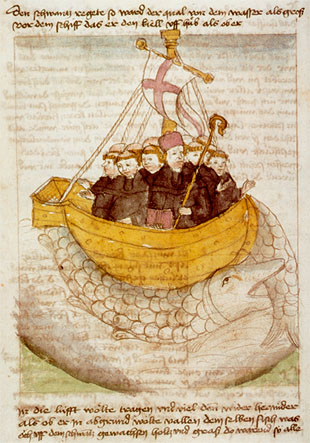
    Saint brendan german manuscript.jpg

    St Brendan -- German manuscript

    1 I feel the winds of God today;
      today my sail I lift,
     though heavy oft with drenching spray
      and torn with many a rift;
     if hope but light the water's crest,
      and Christ my bark will use,
     I'll seek the seas at his behest,
      and brave another cruise.


    2 It is the wind of God that dries
      my vain regretful tears,
     until with braver thoughts shall rise
      the purer, brighter years;
     if cast on shores of selfish ease
      or pleasure I should be,
     O let me feel your freshening breeze,
      and I'll put back to sea.


    I have been reading a book by Monica Weis called Thomas Merton and the Celts which is about the most famous monk of the 21st century's reconnection with his Welsh roots in the final years of his life. Merton was fascinated with the concept of pilgrimage and Weis makes reference to Saint Brendan whose sea voyages were legendary. He may well have sailed to North America centuries before the Vikings. In doing so Weis mentions the book The Brendan Voyage by Tim Severin. I vaguely recollected that in the 1970's Severin and a small crew set sail from Ireland to cross the Atlantic in a coracle, an 11-metre boat made of oxhide and timber, lashed together with linen thread and leather thongs. While this was a re-creation of the sort of Medieval craft Irish monks might have sailed in, it sounded like a recipe for burial at sea.

    If the ancient volume Navigatio, attributed to Brendan, was something of a factual account rather than just an entertaining legend, these sea-faring monks would have taken the "stepping stone" route to North America from Ireland to the Faroe Island,  to Iceland and eventually to Newfoundland. I was curious enough to find the Severin book at the library so I could read the introduction. I found it so intriguing that I devoured the entire thing, absolutely gob-smacked by the courage these modern day explorers demonstrated in a journey fraught with both danger and wonder -- as with any good pilgrimage.

    In the Navigatio Brendan and his monks saw fantastic things including great sea beasts, and flaming rock throwing giants, and towers of crystal through which they could pass. On Severin's voyage their small craft was regularly escorted by pods of dolphins and whales, and eventually they sailed past icebergs pierced by holes. They also stopped in Iceland, which has a number of volcanoes. Hmm.

    Image result for trondur patursson altarpiece

    St. Olaf Church Altarpiece, Faroe Islands --
    Trondur Patursson (Brendan Voyage crew member)

    I actually had goose-bumps when I came to the end and discovered that after 7,700 kilometres of sailing and rowing Severin and crew landed at Musgrave Harbour, Newfoundland, which is only a few kilometres from the pastoral charge I served at the beginning of my ministry. They made landfall almost exactly three years before we arrived in 1980.

    I snooped around in the Navigatio and discovered that Brendan and company measured their progress and landfalls by the church year, including Lent (the season we're in now) and Easter. Even though they didn't know what perils faced them, or whether they would sail off the edge of the world, they were convinced Christ was their companion. Some think that the great hymn of the church, I Feel the Winds of God Today was inspired by Brendan and the Celtic monks who went out to sea. Powerful.

    Comments?

    3 If ever I forget your love
      and how that love was shown,
     lift high the blood-red flag above;
      it bears your name alone.
     Great pilot of my onward way,
      you will not let me drift.
     I feel the winds of God today;
      today my sail I lift.


    https://groundlingearthyheavenly.blogspot.com/2019/03/wild-lent-and-canadian-winters.html
    Some Groundling blog thoughts on Wild Lent and Canadian Winters
    Image result for the brendan voyage book

    Sunday, March 10, 2019

    Wonder, Love, and Praise


    Ruth Kayaking -- St. Martin's New Brunswick

    1 Love divine, all loves excelling,
      joy of heaven to earth come down,
     fix in us thy humble dwelling,
      all thy faithful mercies crown.
     Jesus, thou art all compassion,
      pure, unbounded love thou art;
     visit us with thy salvation,
      enter every trembling heart.


    3 Finish, then, thy new creation;
      pure and spotless let us be;
     let us see thy great salvation
      perfectly restored in thee,
     changed from glory into glory,
      till in heaven we take our place,
     till we cast our crowns before thee,
      lost in wonder, love, and praise.


    Love Divine -- Charles Wesley VU 333

    Yesterday the CBC radio science show, Quirks and Quarks, did a segment on the science of awe. It noted that awe and wonder can be both awe-some and aw-ful, and that religion can evoke both joy and fear. We experience awe listening to music in a church or in the natural world or before beautiful works of art.

    They spoke with a researcher, Beau Lotto, who collaborated with Cirque du Soleil and 280 audience members to explore what happens in the brain. Some were equipped with EEG caps that could read their brain waves while they watched and reacted to what they were seeing. 

    The EEG revealed that activity in their prefrontal cortex, the part of our brain responsible for controlling attention, decreased, reflecting the way the audience members became lost in the experience. Analysis of the data from questionnaires revealed they were affected in several significant ways.
    • They were more willing to take risks.
    • They were more comfortable with uncertainty.
    • They redefined their perceptions of themselves.
    "All of these changes are really quite profound because they're all related to the need and desire to step into uncertainty, which is itself essential for things like creativity, optimism, positive behaviour, decreasing fear, decreasing hate, increasing tolerance etc," said Lotto.

    Image result for exeter cathedral interior

    Exeter Cathedral, Devon (one of my favourites)

    As I listened I thought of the Charles Wesley hymn, Love Divine, which I've sung within large congregations, accompanied by a pipe organ, with choir members singing the descant. Words, music, and the sense of gathered praise created a sense of the divine and it was awe-some.

    I have also walked seashores after a storm when the wind and sheer power of the surf enveloped me and created a sense of both uncertainly and wonder.

    Perhaps we need to engage in worship in ways that take us out of ourselves more often. It's probably why people want to be part of congregations with thousands of people, even when the experience seems rather cheesy and manipulative. Somehow being "Lost in wonder, love, and praise" seems like an awesome idea.

    https://www.cbc.ca/radio/quirks/mar-9-2019-science-of-awe-blue-whales-and-sonar-chromosomes-and-sleep-and-more-1.5047142/exploring-the-powerful-emotion-of-awe-how-it-can-be-awe-some-and-aw-ful-1.5047156

    Image result for cirque du soleil

    Cirque du Soleil

    Saturday, March 09, 2019

    400 Years

    Image result for 400th anniversary of slavery in america

    Only recently did I become aware that this year will mark the 400th anniversary of the first slaves in America. This is certainly not a milestone to be celebrated but it is important that it be recognized. Actually, some scholars are convinced that slaves were brought to America before 1619, but this is the year many will acknowledge this sinful, destructive trade in human lives. Even after emancipation the struggle for equality continues. Some of us are old enough to remember the Civil Rights years and the influence of Christian leaders in this cause, including Dr. Martin Luther King Jr. Many of the issues of inequality remain today.

    I'll share with you this Call to Observance which states so clearly the ongoing need to promote equality. I was taken aback by the note that the Constitution asserted that slaves were 3/5's of person. How did the Founding Fathers decide that a slave was only 60% of a person?

    Image result for 400th anniversary of slavery in america


    We call on everyone to prepare observances for the 400th Anniversary of the arrival in 1619 at Jamestown of the first Africans to be sold into bondage. These Africans were the first of millions that followed as slaves to work on plantations established on land stolen from the indigenous peoples of the continent.

    Colonialism and slavery were soon codified into laws promoting inequality and legitimating oppression and terror. These laws and the practices they encouraged were and remain  formidable barriers against efforts by Native Americans, African Americans, poor whites, and numerous other groups,  to unite against the dispossession and occupation of lands, and exploitative and oppressive life and work conditions.

    Some hundred years after the beginning of the trade in humans, principles that explicitly and emphatically contradicted structures of inequality and dehumanization were enshrined in the Declaration of Independence. Years later, however, the Constitution would advance one of the most pernicious accountings of human worth by asserting that slaves counted as only 3/5’s of a person. The contradictions and hypocrisy evident in the founding documents is manifest today as an elaborate network of social, economic, political and spiritual divisions that reproduce ever more elaborate forms of inequality.

    This accounting of personhood established in the Constitution diminishes the humanity of vast groups of people while elevating others to the status of “natural” supremacy. This ledger of worth and legitimacy constrains all our lives, including the lives of oppressors, for it is spiritually impoverished and forecloses the building of diverse, caring, joyful, and free communities.

    We need desperately to link arms in radical equality.

    Starting now, we can renew and strengthen the long struggle for full emancipation, equity, and justice by coming together to remember the events at Jamestown and the pernicious and persistent devaluing of persons that has been a central structure of U.S. history. We need to unify, account for the past, and assume the rights and responsibility of the future for all if we are to meet the challenges ahead. These challenges include climate change, decaying physical infrastructure, rapidly evolving jobs, underperforming schools, uneven access to health care, and a lack of affordable housing.
    ​
    We call on everyone to prepare observances for the 400th Anniversary of Jamestown. We do this to denounce structures of inequality.
    ​We do this to foreground our fundamental and unconditional equality. We remember and in doing so we refuse to participate in and reproduce structures of dehumanization, exploitation, oppression, and inequity.


    Image result for 400th anniversary of slavery in america

    Friday, March 08, 2019

    Women's Day and Faith

     
    Related image

    I commend to you our sister Phoebe, a deacon of the church at Cenchreae,
      so that you may welcome her in the Lord as is fitting for the saints,
    and help her in whatever she may require from you,
    for she has been a benefactor of many and of myself as well.
    Greet Prisca and Aquila, who work with me in Christ Jesus, 
    and who risked their necks for my life, to whom not only I give thanks,
    but also all the churches of the Gentiles.  
    Greet also the church in their house. Greet my beloved Epaenetus,
    who was the first convert[ in Asia for Christ. 
    Greet Mary, who has worked very hard among you.
    Greet Andronicus and Junia,  my relatives who were in prison with me;
    they are prominent among the apostles, and they were in Christ before I was.

    Romans 16:1-7

    At my mother's memorial service this past November I observed that she had been more of an influence on the development of my faith through her strong, capable witness than my late father, who was also a United Church minister. I thought about her as we approached this International Women's Day, and I have little doubt that many of us can point to the women who have shaped our lives in every aspect, including our spirituality.

    I grew up in a denomination which began ordaining women in the 1930's and while my mother had started life in the Salvation Army she was an officer until deciding to come over to the dark side of the United Church. In my seminary training and during nearly 40 years of ministry the emphasis was always on recognizing the gifts of both women and men. The United Church has hardly been perfect in achieving the goal of equality but I am often startled by how regressive many denominations are in this regard. I found a blog post from 2006 -yikes- in which I reflect on a book I was reading at the time of the anniversary of the Montreal Massacre. Here is a portion of that post:

    I am reading The Lost Apostle by journalist Rena Pederson, about the passing mention of a woman in the last chapter of the apostle Paul's letter to the church in Rome. Her name is Junia, although for centuries this person was called Junius in many translations. It is clearly a woman's name but it was changed to the masculine form because she is described in verse seven as "prominent among the apostles." The reasoning was that a woman couldn't have been identified and honoured by Paul as an apostle, so the name was altered. The book is not scholarly in style but it is very readable and intriguing.

    For so long the church has either marginalized women or treated them as though they are "armed and dangerous." Actually, a number of religions have relegated women to second-class status, arguing both that this is God's will that and that they are really held in higher regard than it appears. These arguments are far from convincing, at least for me.
    How do we honour women in our midst as the people of faith? How do we say that their roles are important? Perhaps we begin, as Paul the supposed misogynist did, with the names of those we cherish.

    Quakers, astrophysics, and Women's Day in my Groundling blog!
    https://groundlingearthyheavenly.blogspot.com/2019/03/quakers-andastrophysics.html

    Thursday, March 07, 2019

    Pondering Pancakes

    Pieter Bruegel the Elder- The Fight between Carnival and Lent detail 3.jpg

    The Fight Between Carnival and Lent (detail), Pieter Bruegel the Elder 1559

    Yesterday I sat in a hair stylist's chair, which in my case is mostly beard-taming.  The stylist to her left commented that her family had a meal of pancakes the night before because it was Shrove Tuesday. Oh ya, said the stylist to the left, we did too. My stylist said, that makes this Ash Wednesday -- I wonder what I should give up for Lent?

    I don't want to indulge in stereotypes, but I did not anticipate hearing about Lent and Shrove Tuesday from these three young women. I was pleasantly surprised.

    Image result for shrove tuesday cartoon

    I read recently that Americans are not inclined to whip up a batch of pancakes on the day before 40-day Lent (plus Sundays) commences -- the States is the land of Mardi Gras, after all. An article in Christianity Today notes pancakes on Shrove Tuesday as a British tradition rather than Canadian but that may in fact be where we get our pancake predilection. The article presents a good explanation for this curious practice:

    Why pancakes? In medieval Europe, Christians often gave up eating rich foods like meat, eggs, and milk for the 40-day period of penance, prayer, and preparation leading to Easter. The practice and duration of the ritual corresponded to Christ’s 40 days of fasting in the desert.

    During Lent, perishable goods would spoil, so pancakes—traditionally just eggs and milk mixed with flour—were the ideal meal for consuming Lenten no-no foods.
     
    But Shrove Tuesday wasn’t just about cleaning out the kitchen. It was also about cleaning out the heart. Shrove is the past tense of shrive, which means to confess sins and to have sins absolved. Priests would ring shriving bells to call pancake-laden parishioners to church to confess their sins—perhaps starting with their gluttony!
     
     
    The author, Judd Birdsall reminds us that "Pancake Tuesday" really need to be "Shrove Tuesday," the housekeeping of the heart which gets us ready for Lent. I agree, and while Pancake Suppers across the land are pleasant church fundraisers it would be good to return to the original intention, or am I crazy?...pass the syrup please...
     
    Image result for church sign pancake supper


    Wednesday, March 06, 2019

    Lent and My Cell Phone

    Image result for david and nathan

    Prayer for Cleansing and Pardon

    1Have mercy on me, O God,
    according to your steadfast love;
    according to your abundant mercy
    blot out my transgressions.
    2Wash me thoroughly from my iniquity,
    and cleanse me from my sin.

    from Psalm 51, a psalm of David, when the prophet Nathan came to him,

    after he had gone in to Bathsheba.

    I can't say "happy Ash Wednesday!" as we enter into Lent, because this is a sombre day at the beginning of what is a contemplative season.

    In my earlier life I was one of those Protestants who looked on bemusedly at Roman Catholics who gave stuff up for Lent. Weird, I thought. What was Lent anyway? Forty days leading up to Easter? We just didn't do the liturgical year in the United Church.

    Lent is kinda weird, but in a good way. It is the lengthy runway of reflective intention which allows us to get airborne as we celebrate the Resurrection. Sometimes that intention involves giving things up, and it may also mean taking things on. There is a discipline to it all which connects to being followers of Jesus -- disciples. The form of this discipline changes from age to age and even over a lifetime.

    In our household we are going to ramp up the number of meatless meals because it's good for our bodies and good for the planet. The critters who would have been dinner might be pleased as well.

    I'm also going to give up distraction for Lent, or at least attempt to reduce distraction by dramatically reducing the use of my cell phone. I was the last of our family to get a "smart" phone which may have made me stupider, and it sure does gobble up time. We'll see how this works out. I can't deceive myself because there is a feature on my phone which will keep me honest...like Nathan did with King David. Do I see a cell phone in one of David's hands?

    Any plans for Lent this year?

    Tuesday, March 05, 2019

    Christopher Pratt and Gentle Jesus


    http://astrotheatre.ca/wp-content/uploads/2019/03/Pratt-Poster-Laurels-with-Staniland-csa-laurels-1050x1617.jpg

    GENTLE Jesus, meek and mild,
    Look upon a little child,
    Pity my simplicity,
    Suffer me to come to thee.


    Charles Wesley hymn and children's prayer

    We were enthusiast screen-watchers as the annual Docfest came to downtown Belleville over the weekend. I took in nine documentaries during the three days and appreciated them all. One of the favourites for both of us was Immaculate Memories: The Uncluttered Worlds of Christopher Pratt. Pratt, now 84, is one of Canada's most celebrated living painters. He's a Newfoundlander who designed the provincial flag and is known for a precise and haunting style to his work. He rambles around Newfoundland with the film-maker, Kenneth Harvey, and their banter is funny, acerbic, and touching.

    Image result for christopher pratt paintings

    Christmas Eve at 12 O'clock -- Christopher Pratt

    At one point Pratt states bluntly (just about everything is stated bluntly) that he has no belief in anything beyond this life. Then he admits that despite this there are occasions when he offers up the on-his-knees prayer of childhood taught to him by his mother: "Gentle Jesus, meek and mild..."

    I've had a lifetime of what I suppose is stubborn belief in God, if belief is the right word. God is, in my rather puny comprehension of existence, and while doubt is a regular companion on my sojourn of faith, God just smiles and persists. I decided along the way that I'm "all in" with Jesus as God incarnate. If there is a Creator I'm open to the Redeemer as well.

    A decade ago the marvelous writer Julian Barnes said in a New York Times piece "that I don't believe in God, but I miss Him. That's what I say when the question is put." Clever, and a bit sad. It seems to me that since the so-called New Atheists including Christopher Hitchens began marauding about vandalizing religion it's become popular to claim that this is all there is, end of story. I'm not inclined to argue with people because they are often as arrogant as the religionists they hold in passive or aggressive contempt. I am more than willing to share a different narrative with those who desire to hear it.

    We loved Immaculate Memories so perhaps I'll offer some specific prayers for Pratt (he'd likely tell me to piss off) as well as general prayers for the non-theists of the world. God loves 'em.

    Image result for immaculate memories pratt


    Sunday, March 03, 2019

    Transfiguration and Thin Places

    Related image

    The Transfiguration - Dominic Martinelli

    Now about eight days after these sayings Jesus took with him
     Peter and John and James, and went up on the mountain to pray.
     And while he was praying, the appearance of his face changed,

    and his clothes became dazzling white.
     Suddenly they saw two men, Moses and Elijah, talking to him.
      They appeared in glory and were speaking of his departure,

    which he was about to accomplish at Jerusalem.
     Now Peter and his companions were weighed down with sleep;

    but since they had stayed awake,
    they saw his glory and the two men who stood with him.
     Just as they were leaving him, Peter said to Jesus,

    "Master, it is good for us to be here; let us make three dwellings,
    one for you, one for Moses, and one for Elijah" -- not knowing what he said.
     While he was saying this, a cloud came and overshadowed them;

    and they were terrified as they entered the cloud.
     Then from the cloud came a voice that said,

    "This is my Son, my Chosen; listen to him!"

    Luke 9:28-35

    This is Transfiguration Sunday, always the Sunday before the beginning of the season of Lent in the liturgical year. Lots of preachers do not like this Sunday because it's, well, a tad weird. Jesus and three disciples hike up a mountain (Hermon? Tabor?) and have a mystifying encounter with two Jewish mountaintop superheroes who had been dead for hundreds of years. There are clouds and confusion and a lame attempt on the part of the disciples to make sense of the incomprehensible.

    Image result for transfiguration contemporary art

    Transfiguration: Armando Alemdar Ara

    Someone suggested recently that this is an example of a "thin place" encounter, in the spirit of the Celtic Christian tradition of places and times when the "membrane" between this life and what is beyond is gossamer thin and permeable. It almost certainly predated Christianity in Ireland with the festival of Samhain becoming Halloween and All Saints and Souls Days. The cheery goblins and carved pumpkins of Halloween had their origins in serious attempts to ward off the unwelcome spirits, even as the welcome saints and ancestors were celebrated.

    In a reflection on thin places Carl McColman offers that:

    certain places truly are holy places, numinous places, places of sacrality — a college word that means “pertaining to the sacred.” It’s what theologians call “the scandal of particularity.” It was originally applied to the Christian belief that Jesus is the one savior of all humankind — and even more than that, the one incarnation of the second person of the Trinity.
    https://www.patheos.com/blogs/carlmccolman/2017/05/thin-places-celtic-pre-celtic-universal/

    Perhaps on this Transfiguration Sunday we can ponder where our thin places are and who we encounter there. We may be like the disciples, confused by the moment and the implications of who Jesus is for us. But it's worth the climb.

    Comments? Thin Places?

    More Transfiguration...and a volcano!...in today's Groundling blog
    https://groundlingearthyheavenly.blogspot.com/2019/03/volcanoes-and-transfiguration.html

    Image result for transfiguration contemporary art


    Saturday, March 02, 2019

    Argh...Have You Been to a Burial at Sea, Billy?

    Captain Brad White

    Captain Brad White -- New England Burials at Sea

    No, I am not obsessed with burying people. In the 20 months since retirement I've presided at one funeral and I have no desire to do more, or become a "Burying Sam" minister who does "insert name here" services for unchurched folk.

    Okay, I will admit that I've written a fair number of blogs on the subject through the years. Alternative vessels for burial including wicker caskets and shrouds and pods. Eco-friendly transportation methods including a bicycle hearse. Planting trees in burial grounds rather than stone markers. Even an initiative to compost the dead...really.

    Image result for bicycle hearse for sale

    Bicycle Hearse with Wicker Casket!

    So it won't surprise you to read that along with "green" burials I've discovered  a company does "blue" burials as well -- burials at sea!

    Captain Brad White’s (not Captain Highliner) first job was sweeping up at his family’s funeral homes but he moved on to corporate work, eventually buying his boat. Brad was asked by a friend about spreading his uncle's ashes at sea, which led to him founding New England Burials at Sea, a Massachusetts-based company that provides full-body burials and ash scattering services at sea. The company now operates out of 75 ports in the United States.

    As Brad describes his business in a Hakai Magazine piece:

    The death care industry has changed quite a bit over the years. People don’t want to be embalmed, they don’t want those poisonous toxins in their body. They don’t want to waste hundreds of thousands of feet of wood for caskets and millions of tonnes of steel for burial vaults. They want to be a part of the planet again—they want their body’s energy to go back into the ocean.

    We have to be at least three nautical miles [5.6 kilometers] out to sea, except in California, where ashes can be spread 500 yards [457 meters] out. Bodies need to be buried in at least 600 feet [183 meters] of water. We use a burial shroud made from a heavy organic cotton duck fiber and weigh the bodies down with four cannonballs. The family might write messages on the cannonballs or messages in the shroud. We anchor the vessel and have a sea tribute, which includes maritime readings, music, and a flag raising. At the family’s cue, the remains go overboard. We fire off the ship’s cannon, circle to a couple of the deceased’s favorite songs, and then come in. We give the family a certificate showing the date, time, latitude, and longitude.

    NEBAS Sea Burial Certified

    While this fascinates me, it's unlikely that I'll change my plans from pushing up daisies to pushing up kelp. And my kayak is built for one, so I won't be inquiring about a franchise for Lake Ontario.

     As unusual as some of these alternatives may seem, our current practices developed over time and as a clergyperson who presided at more than 500 funerals and memorials through the years, some of our "traditions" border on the bizarre. When I began in ministry in 1980 cremation was not that common, so times and practices do change.

    For me it was and still is a matter of dignity and respect in our leave-taking. And it doesn't matter where we are when we affirm our resurrection hope.

    Comments? I know you're dying to say something!
    Image result for burial at sea paintings

    Burial at Sea -- Henry Bacon

    Friday, March 01, 2019

    Evil: More than the Eye of the Beholder

    Image result for evil is in the eye of the beholder globe and mail
     
    and lead us not into temptation,
    but deliver us from evil.
     
    Save us from the time of trial,
    and deliver us from evil.
     
    and do not put us to the test,
    but rescue us from evil.
     
    In times of temptation and test, strengthen us,
    from trials too great to endure, spare us.
    From the grip of all that is evil, free us.
     
    from version and paraphrases of the Lord's Prayer/Prayer of Jesus
    Voices United
     
    Evil was real to Jesus and to the first Christians, as they formed the witness we know as the gospels and the New Testament. When Jesus begins his ministry he goes into the desert he deals with temptations presented by the Evil One -- the Devil or Satan.Through the centuries Christians have repeated the Prayer of Jesus, which speaks of evil and the New Creed of the United Church calls us to "seek justice and resist evil." We rarely define evil but we acknowledge it as the deliberate exploitation and violation of persons and other creatures, by individuals and systems.
     

    Image result for evil is in the eye of the beholder globe and mail
     
    I was curious to see an article in a recent issue of the Globe and Mail newspaper by Julia Shaw with the title Evil is in the Eye of the Beholder. She explores the subjectivity of using the term "evil" which is important. In every time evil manifests itself in different ways and too often we have "demonized" those who are different. Yet from my perspective she keeps sliding down rabbit holes of avoidance which lead to disturbing conclusions:

     
    So, is there really such a thing as evil? Subjectively, yes. You can call sadistic torture or genocide or rape evil. You may mean something very specific and have well-reasoned arguments as to why you have called a particular person or act evil.
     
    We make evil when we label something so. Evil exists as a word, as a subjective concept. But I firmly believe there is no person, no group, no behaviour, no thing that is objectively evil. Perhaps evil only really exists in our fears.
     
    I have but one wish: Please, stop calling people or behaviours or events “evil." It ignores the important nuances of the underlying behaviours. I encourage you instead to think the unthinkable, speak of the unspeakable, explain the unexplainable, because only then can we begin to prevent that which others have deemed unpreventable.
     
    Shaw doesn't refer to religion at all in her article. It's as though the long history of the world's religions and their perspectives on evil don't exist. Perhaps for her they don't, or perhaps there wasn't enough space for her to address this aspect of her exploration of the subject. It's unfortunate. Our Judeo-Christian tradition recognizes that the destructive power of evil is real, and that is both subjective and objective.
     
    When I worked as a chaplain intern in a maximum security prison our chaplain supervisor once told us that for all the reprehensible acts committed by inmates he'd met through the years he'd only felt that he was in the presence of overpowering evil a couple of times. He wasn't denying that evil exists, or that people choose evil. He wanted us to see the prisoners as persons who may have done evil things but were still persons, and presumably children of God. It was a stretch at times, but his directive has stayed with me through the decades.
     
    I will continue to repeat the Lord's Prayer and try to do so with conviction. I need to be rescued from evil, and so does the world. My convictions regarding evil are more nuanced than they once were, but I have no doubt it exists. The United Church statement of faith called A Song of Faith names the various forms sin can take, but it doesn't stop there. The "last word" is this:
     
    Yet evil does not—cannot—
       undermine or overcome the love of God.
    God forgives,
       and calls all of us to confess our fears and failings
       with honesty and humility.
    God reconciles,
       and calls us to repent the part we have played
       in damaging our world, ourselves, and each other.
    God transforms,
       and calls us to protect the vulnerable,
       to pray for deliverance from evil,
       to work with God for the healing of the world,
       that all might have abundant life.
    We sing of grace.
     
    What are your thoughts folks?